Is Your Business Ready for the Future? A Practical Guide to Switching to ERPNext
Discover why hundreds of growing businesses are leaving fragmented tools behind and moving to ERPNext — and how DevDoz makes that transition smooth, fast, and cost-effective.
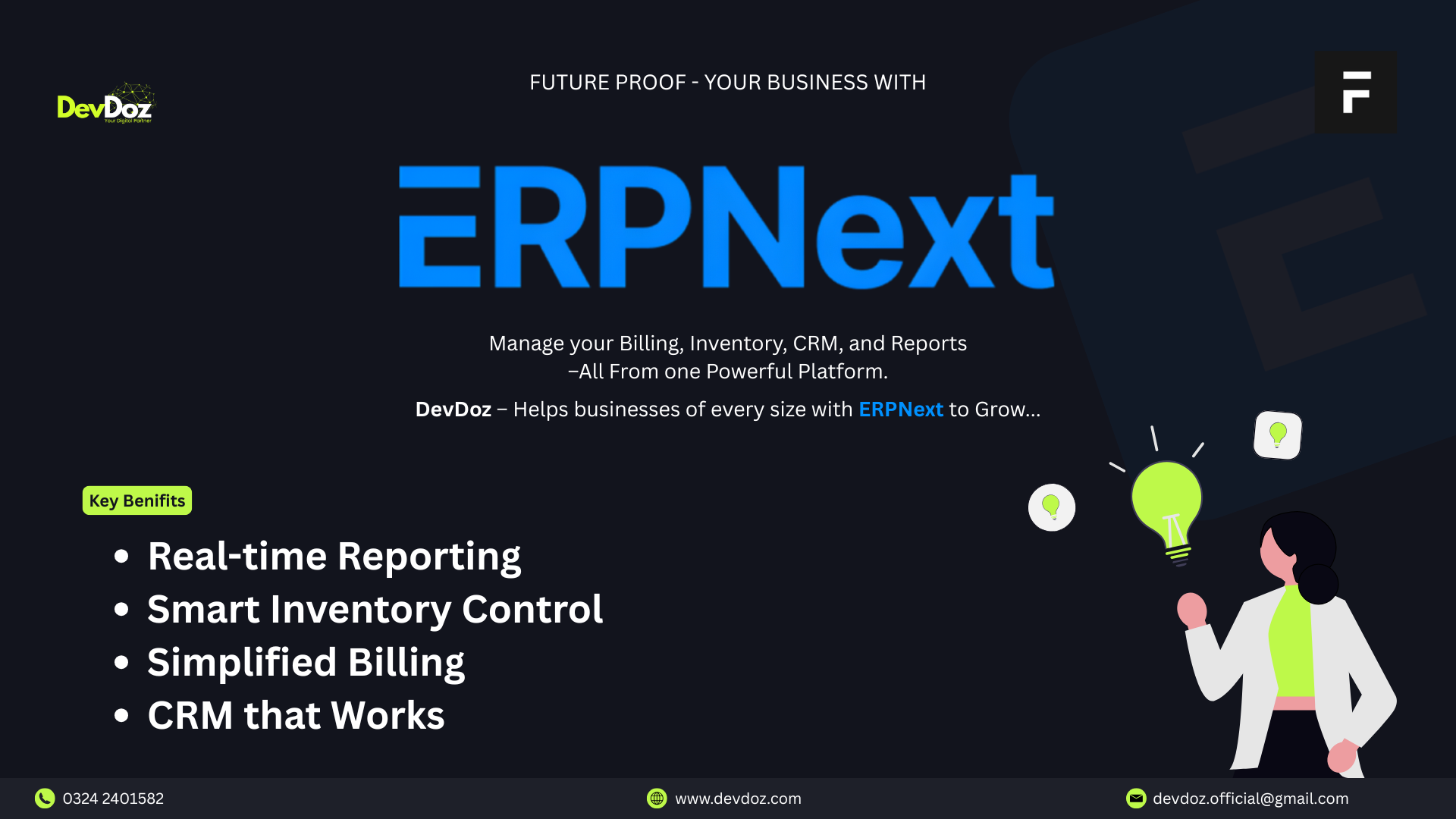
Discover why hundreds of growing businesses are leaving fragmented tools behind and moving to ERPNext — and how DevDoz makes that transition smooth, fast, and cost-effective.
There is a moment that almost every business owner recognises. The spreadsheets stop making sense. The sales team is living in one tool, the warehouse in another, and the accounts department is running on a combination of email threads and gut instinct. Nothing talks to anything else, and every month-end feels like an archaeological dig through data. If that sounds familiar, it is not a sign of failure — it is a sign that you have outgrown the systems you started with.
This is exactly the problem that ERPNext was built to solve. And at DevDoz, helping businesses make that switch cleanly — without disruption and without wasted budget — is one of the core things we do.
What ERPNext Actually Is (And Is Not)
ERPNext is a fully open-source Enterprise Resource Planning platform built on the Frappe Framework. It covers accounting, inventory, manufacturing, CRM, HR, project management, and more — all in a single, connected system. Unlike legacy ERP products that charge per module and per user at enterprise prices, ERPNext is transparent about its costs and genuinely accessible to small and mid-sized businesses.
What ERPNext is not: it is not a plug-and-play tool you download and use out of the box without thought. Like any serious business system, it requires proper configuration, data migration, and a partner who understands your industry. That is where the difference between a smooth transition and a frustrating one is made.
The Real Cost of Fragmented Systems
Before exploring what switching looks like, it is worth being honest about what staying put actually costs. When your billing system does not talk to your inventory, your team is manually reconciling data that a computer should handle automatically. Every manual step introduces the possibility of error. Every error costs time to investigate, and sometimes money to correct.
Beyond the operational friction, fragmented systems create blind spots. If your inventory data is a day behind, you might commit stock you no longer have. If your cash flow view is assembled once a week from three different exports, you are making financial decisions on incomplete information. For a business that wants to grow, these gaps become more expensive over time, not less.
According to research published by Panorama Consulting, companies that successfully implement a unified ERP system report an average 22% reduction in operational costs within the first two years. That figure is not a guarantee, but it reflects what becomes possible when your systems are aligned.
What ERPNext Covers for Your Business
Accounting and Financial Management
ERPNext includes a complete double-entry accounting system. Invoices, payments, bank reconciliation, tax reports, and profit-and-loss statements are all generated within the same platform that manages your sales and inventory. When an order is fulfilled in the warehouse, the financial record updates automatically. There is no export, no import, no copy-paste.
Inventory and Warehouse Management
Stock levels, batch tracking, serial number management, reorder points, and warehouse-to-warehouse transfers are handled natively. You can set automatic reorder rules so that purchase orders are triggered before you run out — not after. For businesses managing multiple warehouses or locations, ERPNext provides a consolidated view across all of them.
CRM and Sales Pipeline
From the moment a lead enters your system to the point where they become a paying customer and beyond, ERPNext tracks every interaction. Sales teams can see the full history of an account, follow up on open opportunities, and generate quotations that flow directly into sales orders — with no re-entry of data required.
HR and Payroll
Employee records, leave management, attendance tracking, and payroll processing are built into the core system. For businesses that currently manage HR in a separate tool, consolidating into ERPNext removes another layer of integration headache.
Project and Task Management
If your business delivers services alongside products, ERPNext's project module lets you track time, costs, and milestones against client projects. Billable hours can be linked directly to invoices, ensuring nothing falls through the cracks.
Common Fears About Switching — and the Reality
"It will disrupt our operations during the transition."
This is the most common concern, and it is a legitimate one. The answer is not to dismiss it but to plan around it. At DevDoz, we run parallel systems during a transition period, meaning your existing tools remain operational while ERPNext is being configured and tested. The go-live moment is controlled, not chaotic.
"Our team will not know how to use it."
ERPNext has one of the most intuitive interfaces of any ERP system available, but no software replaces proper training. We deliver role-based training sessions so that your accounts team, warehouse staff, and sales people each learn exactly what they need to use — not an overwhelming overview of every feature.
"We will lose our historical data."
A proper migration plan means your data moves with you. Customer records, supplier history, opening balances, and inventory valuations are migrated before go-live so that day one on ERPNext does not feel like starting from scratch.
"Open-source means no support."
ERPNext is open-source, but that refers to the code — not the support model. As an implementation partner, DevDoz provides ongoing support, system updates, and customisation work after your go-live. You are not left alone with documentation and a forum.
The DevDoz Implementation Process
We follow a structured process for every ERPNext project because the most expensive ERP implementations are the ones that skip steps.
Discovery: We spend time understanding your business before writing a single line of configuration. What are your workflows? Where do things break down today? What does success look like in twelve months?
Configuration and Customisation: ERPNext is configured to reflect how your business actually works, not the other way around. If your invoicing has specific requirements, or your inventory uses non-standard units, those are handled in the configuration phase — not treated as exceptions.
Data Migration: Your existing data is cleaned, mapped, and imported. This step is often underestimated, but it is one of the most important. Bad data in means bad data out, so we take the time to do it properly.
Testing: Before anything goes live, your team runs real scenarios through the system. This is your opportunity to catch anything that does not match your expectations before it affects real operations.
Training and Go-Live: We train your team and stay close during the first weeks after launch. Questions come up; we answer them. Adjustments are needed; we make them.
Ongoing Support: After go-live, we are available for enhancements, bug resolution, and system updates. ERPNext evolves, and so should your implementation.
Is ERPNext Right for Every Business?
Honestly, not every business needs a full ERP system right now. If you have five employees and very simple operations, the overhead of an ERP may not be justified yet. But if you are managing more than a handful of people, dealing with inventory in any serious volume, running sales and purchasing simultaneously, or finding that your month-end close takes longer than it should — then the answer is almost certainly yes.
The businesses that benefit most from ERPNext are those in a growth phase where the old ways of working are becoming a ceiling, not a floor. If you are at that point, it is worth having a proper conversation about what a transition would look like for your specific situation.
You can read more about how we approach ERP work in our post on AI automation and business trends, or explore how we think about digital systems in our web development trends guide.
Ready to Take the Next Step?
If you are curious about what switching to ERPNext would involve for your business, the best starting point is a conversation — not a sales pitch. We will look at what you are working with today, what you want to achieve, and whether ERPNext is the right fit. If it is not, we will tell you that too.
Get in touch with the DevDoz team and let us talk through your situation. There is no pressure and no obligation — just an honest discussion about whether this makes sense for you.
Frequently Asked Questions

Muhammad Ali Husnain
Frappe ERPNext Specialist & Tech Lead @ DevDoz
Muhammad Ali Husnain specializes in Frappe ERPNext architecture, custom doctype development, and AI process automations for enterprise clients across Pakistan, Saudi Arabia, and the UAE.
Tags
Share this article
Related Articles
Explore our latest insights, tutorials, and updates from the DevDoz team.
Best AI Automation Practices for 2025: What Actually Works in the Real World
Moving beyond the hype, this guide covers the AI automation approaches that are delivering measurable results for businesses in 2025 — from choosing the right processes to automate, to governance, tooling, and sustainable scaling.
Web Development in 2025: The Shifts That Are Actually Changing How We Build
Edge computing, AI-assisted development, progressive web apps, and the shift toward performance-first architecture — a grounded look at what is genuinely changing in web development and what you should be paying attention to.
AI Automation and Business in 2026–2027: Practical Trends for Your Operations
Generative AI, autonomous agents, and self-hosted workflow automation have matured beyond experimental phases. Here is a practical analysis of what actually delivers ROI in 2026 and 2027, along with operational risks and strategic recommendations.