Muhammad Ali Husnain: Building DevDoz and What I Learned Along the Way
From teaching myself to code to launching a digital studio that helps businesses automate and grow — this is the story of how DevDoz came to exist, the mistakes I made, and what actually mattered.
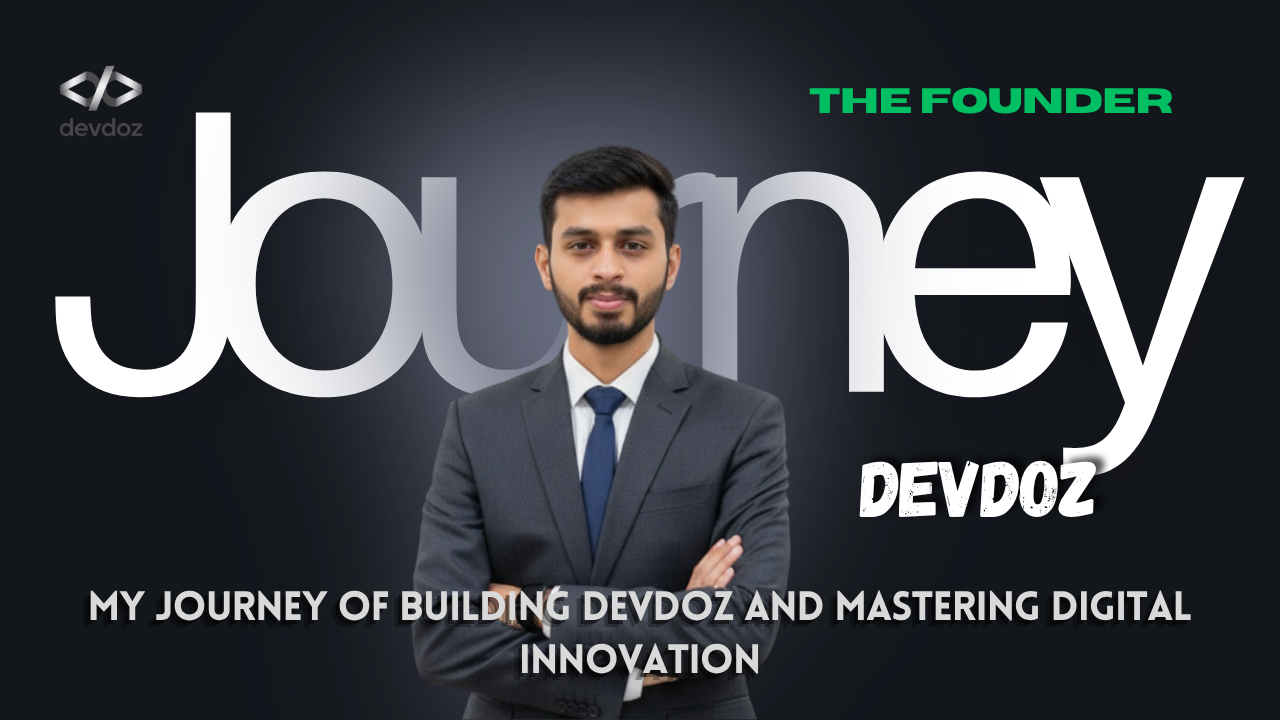
From teaching myself to code to launching a digital studio that helps businesses automate and grow — this is the story of how DevDoz came to exist, the mistakes I made, and what actually mattered.
I did not start out with a business plan. I started out with a problem I wanted to solve and a stubbornness about figuring out how to solve it. That is probably not the origin story that makes investors comfortable, but it is an honest one — and honesty about what actually happened, rather than a polished narrative, is something I have come to value more as DevDoz has grown.
This post is not a case study or a pitch. It is an attempt to write honestly about the journey of building something technical from scratch, what I got wrong in the early years, and what I believe now about what it takes to build a digital business that lasts.
The Beginning: Learning Without a Roadmap
I taught myself to code at a time when the resources available were a fraction of what they are now. There was no structured curriculum to follow, no bootcamp with a job guarantee at the end. There were documentation pages, Stack Overflow threads, and the slow, frustrating process of building something, watching it break, and figuring out why.
The early projects were small and largely meaningless in commercial terms. But they were not meaningless in terms of what I learned. Each one forced me to confront something I did not understand yet, and working through that — often at midnight, often with no one to ask — built the kind of problem-solving instinct that is difficult to acquire in any other way.
I worked across enough technology to know what I was drawn to and what I was not. Frontend work appealed to me because of the immediate feedback loop — you change something and you can see it. But backend systems were where the real leverage was. The ability to build a system that handles something automatically, reliably, at any scale, is what eventually pulled me toward automation and ERP work.
The Decision to Build DevDoz
DevDoz did not launch on a specific date with a launch party and a press release. It grew out of a recognition that the work I was doing for clients — building systems, automating processes, integrating tools — was valuable enough that it warranted a proper studio rather than a freelance arrangement.
The name reflects something I believed from the start: development, done properly, is a creative act as much as a technical one. A well-built system has a kind of elegance to it. The decisions made in architecture and design — which trade-offs to accept, which abstractions to build, which conventions to follow — all of these shape whether a system is a pleasure to work with or a burden to maintain. I wanted to build the first kind.
The early focus was full-stack web development with a particular interest in Frappe and ERPNext. That focus made sense because the demand was clear: businesses of all sizes were discovering that their existing systems could not scale with them, and ERPNext offered a serious, open-source solution that did not come with the price tag of SAP or Oracle.
What I Got Wrong Early On
I underestimated the importance of scoping. In the early days, I took on projects with vague requirements because I was confident I could figure things out as I went. Sometimes that worked. More often, it led to scope creep, underpriced work, and projects that took twice as long as they should have.
The lesson I eventually internalised is that time spent clarifying requirements before starting a project is never wasted. Every hour of discovery at the beginning saves three hours of correction in the middle and five hours of dispute at the end. This is now one of the principles that shapes how DevDoz operates: we do not start building until we understand what we are building and why.
I also underestimated how much of running a digital business is communication rather than technical work. Writing clearly about what a system does, explaining trade-offs in terms a non-technical client can understand, managing expectations honestly when timelines shift — these are skills that took time to develop, and the cost of not having them early was paid in strained client relationships.
The Skills That Have Actually Mattered
Technical depth matters, obviously. Understanding how systems actually work — not just how to use them but what is happening underneath — means you can debug things that other people cannot and design things that hold up under real conditions. Time spent going deep on the Frappe framework, on database design, on how APIs behave under load — all of that has paid back many times over.
But the skills I undervalued in the early years were the ones that sit adjacent to technical work. The ability to read a business process, understand where the friction is, and translate that into a system design is not a purely technical skill. It requires curiosity about how organisations work and empathy for the people who use the systems you build. The most technically elegant solution that does not match how people actually work is a failure, regardless of how clean the code is.
Writing has also turned out to matter more than I expected. The DevDoz blog exists partly because I believe in sharing what I know — there is something uncomfortable about treating knowledge as a competitive advantage to be hoarded. But it also exists because writing clearly about technical topics is one of the most reliable ways to build credibility, attract clients who are a good fit, and contribute something genuinely useful to the conversations happening in our industry.
What DevDoz Does Now
The studio focuses on three areas that overlap and reinforce each other. The first is ERP implementation and customisation — primarily ERPNext and Frappe, helping businesses move from fragmented tools to unified systems that give them real-time visibility into their operations. You can read more about that in our post on switching to ERPNext.
The second is automation — building workflows that connect systems, process data, and handle repetitive tasks without requiring human intervention at each step. This spans everything from simple integrations between existing tools to complex multi-step processes using platforms like n8n. Our thinking on this is covered in more detail in our guide to AI automation practices.
The third is web development — building applications and sites that are fast, well-structured, and maintainable. This is not template-based work; it is custom development for clients who need something specific and are willing to invest in doing it properly.
Where This Goes Next
The goal is not to become a large agency. It is to remain a studio that does excellent work, maintains a genuine understanding of the projects it takes on, and builds long-term relationships with clients rather than treating every engagement as a one-time transaction.
I am interested in how AI tools change the economics and possibilities of custom software development. Not in a breathless, everything-will-be-different-in-six-months way, but as someone who is actively experimenting with what becomes possible when the cost of certain kinds of technical work drops significantly. The clients who benefit most from that shift are the ones who have a clear sense of what they want to build and why — which is why the discovery process matters as much as it does.
If you want to follow the work DevDoz is doing, the blog is the best place to do that. And if you have a project you want to discuss — whether it is an ERP implementation, an automation challenge, or a web development brief — the conversation starts here.
— Muhammad Ali Husnain

Muhammad Ali Husnain
Frappe ERPNext Specialist & Tech Lead @ DevDoz
Muhammad Ali Husnain specializes in Frappe ERPNext architecture, custom doctype development, and AI process automations for enterprise clients across Pakistan, Saudi Arabia, and the UAE.
Tags
Share this article
Related Articles
Explore our latest insights, tutorials, and updates from the DevDoz team.
Is Your Business Ready for the Future? A Practical Guide to Switching to ERPNext
Discover why hundreds of growing businesses are leaving fragmented tools behind and moving to ERPNext — and how DevDoz makes that transition smooth, fast, and cost-effective.
Best AI Automation Practices for 2025: What Actually Works in the Real World
Moving beyond the hype, this guide covers the AI automation approaches that are delivering measurable results for businesses in 2025 — from choosing the right processes to automate, to governance, tooling, and sustainable scaling.
Web Development in 2025: The Shifts That Are Actually Changing How We Build
Edge computing, AI-assisted development, progressive web apps, and the shift toward performance-first architecture — a grounded look at what is genuinely changing in web development and what you should be paying attention to.