How ERPNext Streamlines Complex Business Processes and Drives Operational Efficiency
Fragmented software applications create hidden operational drag that slows down enterprise growth. Discover exactly how centralizing your workflows on ERPNext removes operational silos, eliminates double data entry, and scales execution efficiency across finance, inventory, and operations.
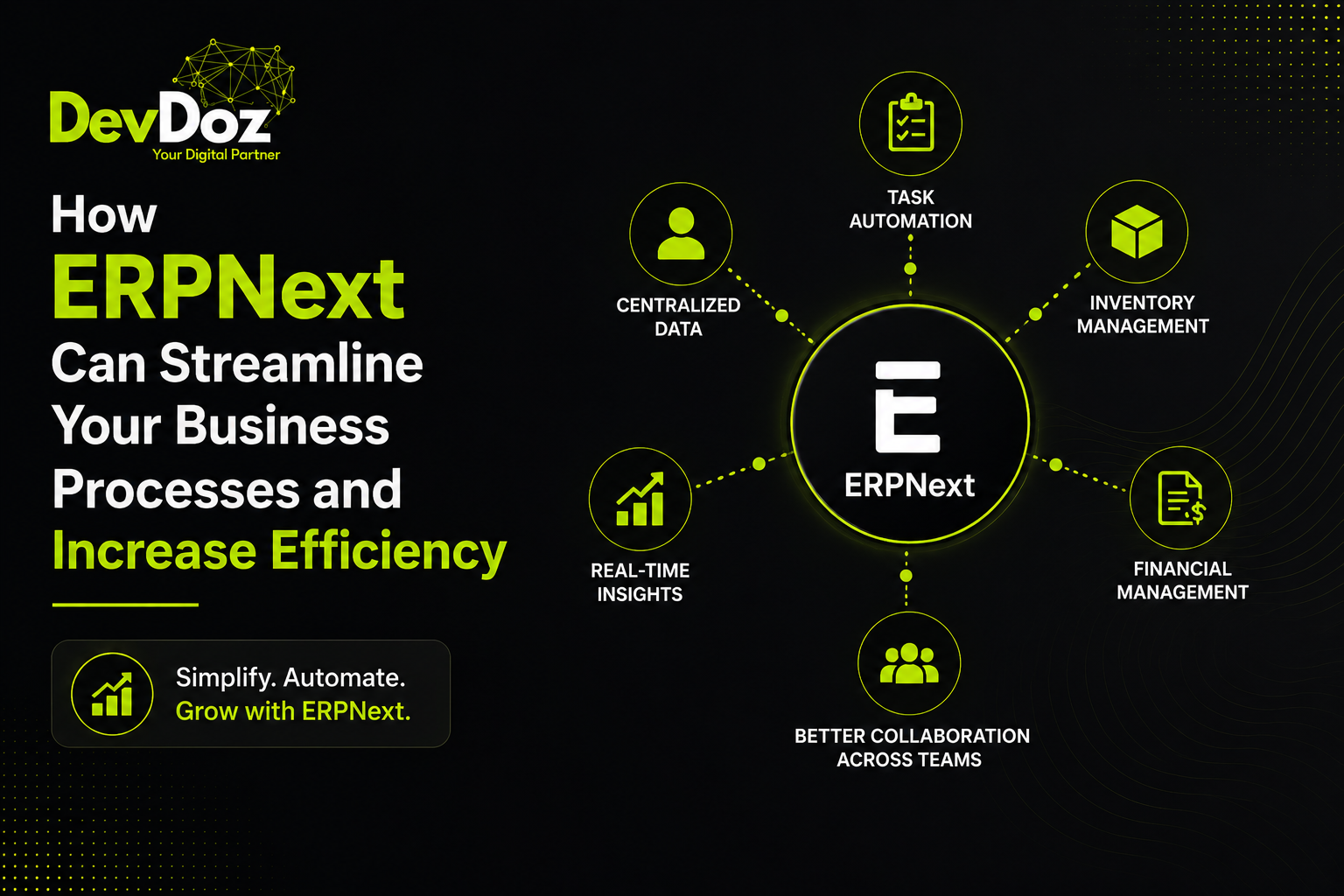
Fragmented software applications create hidden operational drag that slows down enterprise growth. Discover exactly how centralizing your workflows on ERPNext removes operational silos, eliminates double data entry, and scales execution efficiency across finance, inventory, and operations.
When enterprise operations expand past a foundational threshold, leadership teams inevitably discover a hidden structural drag on their growth: the accumulation of disconnected software solutions. It typically manifests as an administrative tax on every transaction. The sales team closes a contract in an isolated CRM platform, the operations team tracks execution via complex custom spreadsheets, the warehouse team coordinates raw inventory through standalone logs, and the accounting department spends days manually reconciling invoices across independent databases. This fragmentation does not just cause communication delays; it actively degrades data integrity and slows down executive decision-making.
True operational efficiency cannot be achieved by forcing disconnected applications to communicate through fragile, custom-built API connectors. Instead, it requires complete architectural consolidation. By deploying ERPNext—the world's most adaptive open-source enterprise resource planning system—built on the single-database architecture of the Frappe Framework, businesses can establish a single, trusted source of truth. Every transaction, stock movement, and ledger entry flows naturally across departmental boundaries in real time without human intervention.
At DevDoz, we engineer high-performance ERPNext implementations that transform disjointed business workflows into streamlined, platform-driven operations. This guide provides a detailed analysis of how ERPNext simplifies complex corporate processes, removes operational friction, and maximizes engineering and financial efficiency across your entire enterprise architecture.
1. The Order-to-Cash Cycle: Unifying Sales, Inventory, and Finance
In many fragmented business operations, the Order-to-Cash pipeline is constantly slowed down by manual validation steps. A sales representative closes a deal, but must then email the warehouse to verify physical stock availability, wait for the accounting team to manually assess the customer’s credit risk, and manually re-key transaction data to generate a formal invoice. Each manual step delays fulfillment and introduces opportunities for data entry errors.
ERPNext streamlines this entire pipeline by managing it as a single, continuous workflow. Because the CRM, Inventory, and Accounts modules operate on the exact same relational database schema, the moment an inquiry converts into an authorized Sales Order, the system instantly executes cross-departmental operations:
- Real-Time Stock Reservations: The platform cross-references active stock across multiple warehouses, placing an immediate hold on the required items to prevent double-selling.
- Automated Credit Checks: The accounting ledger instantly reviews the customer's historical accounts receivable balance against their pre-approved credit limits, placing orders that exceed safety thresholds on an automated administrative hold.
- Immediate Delivery Workflow Generation: A formal delivery note is dynamically routed to the designated fulfillment center’s packing queue without requiring any manual email notifications.
When the warehouse logs the physical dispatch, the platform simultaneously records the stock reduction via FIFO or moving average valuation and generates a draft Sales Invoice. This seamless transactional flow reduces the administrative processing timeline from days to minutes, ensuring rapid customer fulfillment and optimizing working capital efficiency.
2. The Procure-to-Pay Pipeline: Automating Procurement and Inventory Replenishment
Uncoordinated purchasing processes often lead to two major operational failure modes: costly stockouts that disrupt fulfillment or excess raw material inventory that ties up significant company capital. Manual procurement strategies rely heavily on managers spotting inventory shortfalls through manual checks—a method that scales poorly as a company expands across multiple branches or product variants.
ERPNext converts this reactive manual process into a highly structured, automated workflow using rule-based inventory parameters. By establishing explicit **Auto Reorder Levels** within the item configuration profiles, your purchasing loop runs completely independently. When an asset or item drops below your safety stock threshold due to a point-of-sale transaction or delivery fulfillment, ERPNext immediately initiates an automated replenishment process.
The platform instantly builds a Material Request or compiles a draft Purchase Order targeted directly at your primary supplier, incorporating pre-negotiated price lists and tax templates. Furthermore, to safeguard your company's cash flow, ERPNext enforces strict three-way matching before accounts payable can authorize payments. When a supplier invoice is recorded, the platform cross-references the billed amounts against the original Purchase Order and the formal digital Purchase Receipt issued by your receiving dock. If any quantities or values exceed your allowed tolerances, the system halts payment automation and flags the document for management review, ensuring complete control over expenditures.
3. Financial Architecture: Real-Time Double-Entry Ledger Posting
Traditional accounting structures frequently operate under a severe lag. Because transactions are recorded across isolated operations tools, financial teams must invest significant effort at the end of every month exporting CSV files, correcting human data entry errors, and manually balancing ledgers. Consequently, leadership teams routinely make strategic expansion decisions based on financial performance insights that are already weeks out of date.
ERPNext completely eliminates this reporting delay through its native double-entry ledger integration. There is no isolated batches phase or end-of-day posting requirement; every single operational event across your business instantly generates its corresponding accounting entry:
- A warehouse delivery note immediately records an inventory asset reduction and adjusts the Cost of Goods Sold (COGS).
- A point-of-sale transaction instantly updates localized tax ledgers and registers cash receipts.
- An international purchase order automatically handles multi-currency conversions and logs unrealized currency exchange adjustments based on real-time central exchange metrics.
This deep integration ensures that your trial balances, cash flow statements, and profit-and-loss reports are completely accurate and audit-ready at any given second. Executives can monitor operating margins dynamically across distinct cost centers or regional entities, allowing them to adjust business strategies based on reliable, live financial data.
4. Workforce Optimization: Centralizing HR and Cross-Departmental Workflows
Operating a business efficiently requires minimizing administrative overhead within human resources and payroll operations. When employee logs, leave approvals, shifts, and payroll distributions are managed via fragmented spreadsheets, HR departments spend excessive time handling manual calculations and resolving employee disputes.
ERPNext integrates workforce operations directly into your primary enterprise core. Employees gain access to a dedicated self-service portal where they can request leave, log expenses, and view their pay slips independently. When an expense claim is uploaded, the workflow engine automatically routes the request through a multi-level approval chain based on company hierarchy, validating expenditures against pre-set department budgets before authorization.
The real efficiency, however, lies in payroll processing. Because the HR module connects directly with project sheets, attendance trackers, and localized tax configurations, generating monthly payroll for hundreds of employees becomes a brief configuration review rather than an extensive spreadsheet task. Salary components, statutory deductions (such as income tax withholding, provident funds, or regional healthcare contributions), and overtime wages are calculated automatically, with the system instantly posting corresponding financial journal entries across your corporate cost centers.
5. Extensibility via the Frappe Framework: Eliminating Integration Tech Debt
A primary reason legacy ERP implementations fail to scale efficiently is the rigid nature of their software design. When a business needs to adapt a standard process or build a custom module to support a unique competitive advantage, legacy platforms often require expensive, specialized consultants or complex external software integrations that fracture during minor system updates.
ERPNext completely addresses this flexibility problem through the decoupled, metadata-driven architecture of the Frappe Framework. The system treats all fields, workflows, and dashboard elements as configurations (DocTypes) stored within the database. This allows engineering teams to customize existing system behavior, introduce specialized data fields, or build entirely custom modules seamlessly without modifying the underlying core codebase.
For advanced enterprise automation, the platform includes native support for inbound and outbound webhooks, comprehensive REST APIs, and server-side Python scripting. If your team needs to orchestrate highly complex multi-system automations—such as linking ERPNext data with custom mobile tracking apps, external logistics platforms, or communications tools—you can easily pair the system with workflow managers like n8n. This structural flexibility ensures that your core business architecture easily adapts to your changing operational workflows over time without accumulating brittle integration tech debt.
Transitioning toward High-Efficiency Operations
Replacing isolated software tools with a centralized ERP platform like ERPNext is a major milestone in a company's digital maturity. It demands an intentional strategy, clean master data migration, and a thorough understanding of your team's everyday workflows. However, the operational rewards are definitive: complete visibility across your organization, total data integrity, and a highly scalable architecture capable of supporting rapid business growth.
At DevDoz, we focus on translating complex, real-world corporate processes into high-performance, maintainable ERPNext workflows. We remove configuration risks and deliver clean, dependable architectures engineered specifically to scale your business. To build a stronger foundation for your automation journey, explore our practical analysis of automating your business workflows in 5 steps, study our strategic playbook on leveraging ERPNext for long-term business scaling, or read our executive blueprint regarding navigating ERP staff augmentation to optimize your internal development speed.
Stop letting fragmented systems create administrative drag on your operations. Connect with the DevDoz software engineering team today to schedule a comprehensive operational review and discover exactly how a clean ERPNext implementation can streamline your processes and maximize execution efficiency.
Frequently Asked Questions

Ali Husnain
Frappe ERPNext Specialist & Tech Lead @ DevDoz
Muhammad Ali Husnain specializes in Frappe ERPNext architecture, custom doctype development, and AI process automations for enterprise clients across Pakistan, Saudi Arabia, and the UAE.
Tags
Share this article
Related Articles
Explore our latest insights, tutorials, and updates from the DevDoz team.
How ERPNext Helps Your Business Grow and Scale — Without Changing Systems Again
Most businesses hit a growth ceiling not because they run out of customers or ideas, but because their systems cannot keep up. ERPNext is built specifically to remove that ceiling — here is exactly how it does it, across every part of your operation.
Automate Your Business with ERPNext in 5 Steps: The Definitive Operational Playbook
Automating fragmented business processes doesn't require multi-million dollar corporate systems. Discover our proven, 5-step operational framework to successfully implement ERPNext automation, remove manual data entry, and scale clean workflows across your entire enterprise architecture.
Don’t Let Your ERP Project Stall: The Ultimate Guide to ERP Staff Augmentation
ERP implementations don't fail because of software limitations; they fail due to sudden resource bottlenecks. Discover how strategic ERP staff augmentation injects precise engineering talent to eliminate technical gaps, accelerate delivery timelines, and maintain project momentum.