How ERPNext Helps Your Business Grow and Scale — Without Changing Systems Again
Most businesses hit a growth ceiling not because they run out of customers or ideas, but because their systems cannot keep up. ERPNext is built specifically to remove that ceiling — here is exactly how it does it, across every part of your operation.
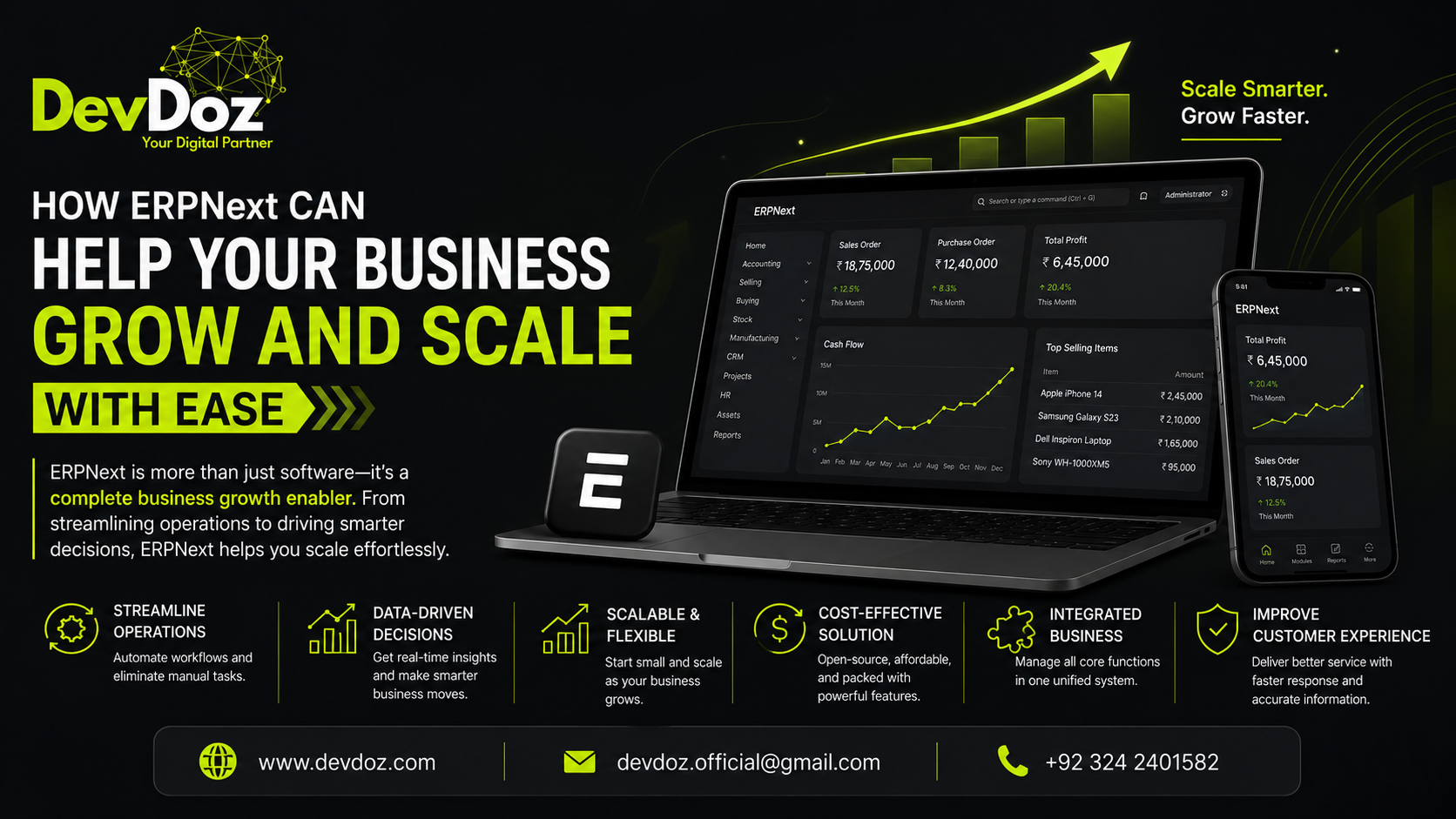
Most businesses hit a growth ceiling not because they run out of customers or ideas, but because their systems cannot keep up. ERPNext is built specifically to remove that ceiling — here is exactly how it does it, across every part of your operation.
There is a particular kind of operational pain that hits businesses at a specific stage of growth. It usually arrives somewhere between fifteen and fifty employees, or when the second location opens, or when the product line doubles. The symptoms are recognisable: month-end close takes longer than it used to. Stock discrepancies appear regularly and nobody is quite sure where they come from. The finance team is reconciling data between systems that were never designed to talk to each other. Reports that should take minutes take a day, because the data has to be assembled manually from four different places.
This is not a people problem. It is a systems problem. The tools that got the business to this point were chosen for a business that was smaller, simpler, and less demanding. They are not wrong — they are just no longer enough.
ERPNext is the answer to that specific problem. Not because it has the most features or the biggest marketing budget — it does not — but because it is built from the ground up to handle the operational complexity that comes with genuine business growth, without the licensing costs that make enterprise ERP platforms inaccessible to the businesses that need them most.
At DevDoz, we work with businesses at exactly this inflection point. This article is an honest account of how ERPNext enables growth — not a feature list, but a clear explanation of what changes when a properly implemented ERPNext system sits at the centre of your operations.
Unified Operations: Running Everything From One Platform
The most immediate way ERPNext enables growth is by eliminating the operational drag of fragmented systems. Most businesses that come to us are running their operations across three, four, or five separate tools: accounting in one place, inventory in another, CRM somewhere else, HR in a spreadsheet, purchasing managed through email chains. Each tool works reasonably well in isolation. Together, they create a coordination overhead that scales badly as the business grows.
Every transaction that touches more than one system requires manual reconciliation. A sale that updates the CRM needs to be manually reflected in inventory. A purchase that is receipted in the warehouse needs to be manually matched to the supplier invoice in accounts. When these reconciliations are done daily and accurately, the cost is time. When they slip — which they do, under pressure — the cost is data integrity, and data integrity problems compound.
ERPNext connects all of these functions within a single platform. Accounting, inventory and warehouse management, purchasing, sales and CRM, manufacturing, HR and payroll, project management, and point of sale are all modules within the same system, sharing the same database, operating on the same transaction data. When a sales order is confirmed, it creates a delivery obligation in the warehouse automatically. When goods are dispatched, it creates a stock movement and a revenue entry simultaneously. When a supplier invoice arrives, it is matched against the existing purchase order and goods receipt in a three-way match that catches discrepancies before they are paid.
The result is not just efficiency — it is accuracy. A business where data flows automatically between functions is a business where the numbers are trustworthy, and trustworthy numbers are the foundation on which good growth decisions are made.
Real-Time Visibility: Making Decisions on Current Information
Growth decisions — whether to hire, whether to expand, whether to enter a new market, whether a particular product line is generating the margin it appears to — are only as good as the information they are based on. A decision made on last month's data, assembled over three days from multiple system exports, is a decision made with a significant information lag.
One of the least glamorous but most operationally significant things ERPNext does is make information current. Because every transaction posts to a shared database in real time, reports reflect the actual state of the business at the moment they are generated — not the state at the close of the last period, not the state as of the last export, but right now.
Cash flow is visible without a reconciliation exercise. Inventory levels across all locations are current without a warehouse count. The receivables ageing report shows exactly who owes what and for how long. The gross margin on any product, customer, or sales channel can be calculated at any moment, not assembled at month-end from data that may or may not agree with itself.
For a business owner or operations manager making decisions about where to focus growth effort, this kind of visibility changes the quality of the decisions. You stop managing by approximation and start managing by evidence. That is a structural advantage that compounds over time as the business grows and the decisions become more consequential.
Scalability Without a System Change: Growing Inside ERPNext
One of the hidden costs of fragmented tooling is the system change cycle. A business that outgrows its accounting software needs to migrate to a new one. A business that outgrows its inventory system needs to evaluate and implement a replacement. Each of these migrations is expensive, disruptive, and takes organisational attention away from growth. And the cycle repeats as the business continues to scale.
ERPNext is built to eliminate that cycle. The platform's architecture is designed to handle business complexity from ten employees to several thousand, from one location to hundreds, from a single currency to a fully multi-currency international operation — all within the same system, with no migration required as the business grows.
Adding new locations and branches
When a business opens a second location, ERPNext adds a new warehouse, a new cost centre, and a new POS profile. The existing system configuration — the chart of accounts, the item catalogue, the customer records, the supplier relationships — is all inherited automatically. The new branch is operational in the system within hours, not weeks. Consolidated reporting across all locations is available immediately, because the data is in one place.
Adding new entities and companies
For businesses that grow through acquisition or by establishing separate legal entities in new markets, ERPNext supports multi-company operations natively. Each company has its own chart of accounts, its own books, its own financial statements. Inter-company transactions — stock transfers between entities, management fee billings, loans between companies — are handled with built-in inter-company functionality that keeps the consolidated and entity-level accounts aligned.
Adding new users and departments
ERPNext's role-based permission system means that adding a new user is a configuration task, not an engineering project. The new user is assigned the roles appropriate to their function — warehouse operative, accounts payable clerk, sales manager, HR administrator — and they see exactly the modules and documents their role requires, nothing more and nothing less. The system scales to hundreds of concurrent users on standard cloud infrastructure without a platform change.
Adding new modules as the business evolves
A business that starts on ERPNext for accounting and inventory can add manufacturing when production begins, HR and payroll when headcount warrants it, project management when service delivery becomes complex, and e-commerce when the business moves online. Each module is available within the same platform and connects automatically to the data already in the system. There is no integration project, no data migration, no new vendor relationship to manage.
Inventory and Supply Chain: The Engine of Physical Business Growth
For businesses that sell or manufacture physical goods, inventory management is the operational function where growth either accelerates or stalls. A business that cannot reliably know what it has, where it is, and what it costs cannot confidently commit to customer orders, cannot optimise its purchasing, and cannot understand its true margins.
ERPNext's inventory module handles the full complexity of physical goods management. Multiple warehouses, batch and serial number tracking, item variants (size, colour, material), reorder point automation, stock valuation by FIFO or moving average, and physical count reconciliation are all native capabilities.
The reorder automation deserves particular attention for growing businesses. Rather than relying on a warehouse manager to notice when a fast-moving item is running low, ERPNext monitors stock levels against configured reorder points continuously. When a threshold is crossed, a purchase order is automatically generated and routed through the configured approval workflow. The item is replenished before it becomes a stockout, not after. At scale, across hundreds of items and multiple warehouses, this automation prevents the revenue loss and customer dissatisfaction that comes from stockouts that manual monitoring consistently misses.
For manufacturing businesses, the integration between the bill of materials, production planning, and inventory is particularly powerful. When a production order is raised, the system checks raw material availability automatically, flags shortages, and updates finished goods inventory when production is completed. The cost of goods produced — including material costs, labour costs, and overhead allocation — posts to the accounts without manual calculation.
Automation: Eliminating the Work That Does Not Need a Human
Growth without automation means hiring proportionally to revenue — which is the wrong relationship. ERPNext's workflow automation engine allows businesses to eliminate manual steps from their processes not by replacing people, but by removing the repetitive, rule-based work that consumes their time and creates unnecessary opportunities for error.
Purchase order approvals that currently require a manager to be physically present can be configured as an email-based approval workflow with escalation if not actioned within a defined period. Supplier invoices that match the purchase order and goods receipt within tolerance can be set to auto-submit for payment without manual intervention. Low stock alerts, payment reminders, contract renewal notifications, and employee leave approvals can all be triggered automatically based on conditions in the data.
The Frappe Framework's workflow engine handles these automations without custom code for most standard scenarios. Where more complex automation is required — integrating ERPNext with an external API, triggering an ERPNext workflow from a third-party event, or building a custom approval chain with conditional logic — the Frappe Framework's webhook support and server script capability provide the tools to build it properly.
At DevDoz, we also implement automation layers on top of ERPNext using tools like n8n for clients who want to connect their ERPNext data to external systems — e-commerce platforms, shipping providers, customer communication tools — without bespoke integration code. This approach is covered in more detail in our guide on AI and automation practices for 2025.
Financial Control at Scale: Accounting That Grows With the Business
A common failure point as businesses scale is that financial control weakens rather than strengthens. With more transactions, more entities, more currencies, and more people touching financial data, the opportunities for error multiply. ERPNext's accounting module is designed to maintain control as complexity increases, not to become a bottleneck.
The double-entry accounting engine is complete and audit-compliant. Every transaction generates the correct journal entries automatically — there is no separate step to "post to accounts" because posting happens at the point of transaction. The trial balance is always current. The profit and loss and balance sheet reflect real-time data.
Multi-currency operations are handled natively. A business importing goods in USD and billing customers in SAR or PKR manages currency conversion in the system, with exchange rates updated centrally and applied automatically to transactions. Period-end currency revaluation posts the correct unrealised gain or loss entries without manual calculation. For businesses expanding internationally, this removes a significant source of accounting complexity.
The accounts payable and receivable processes have explicit approval stages, payment terms enforcement, and ageing monitoring built in. Suppliers are paid on the correct terms. Customers are followed up when invoices become overdue. The cash position is always visible. For a growing business where cash flow management is increasingly consequential, this level of control is not a luxury — it is a necessity.
CRM and Sales: Managing More Customers Without Losing the Personal Touch
Growth in revenue means growth in customer relationships, and managing more customers without a proper system means the quality of those relationships inevitably deteriorates. ERPNext's CRM module provides the structure that allows a sales team to scale its activity without losing track of commitments, follow-ups, or customer history.
Leads and opportunities are tracked through a configurable pipeline with stage-based visibility. Every interaction — call, email, meeting, quotation — is logged against the customer record. Follow-up tasks and reminders prevent opportunities from going cold because someone forgot to call back. When a lead converts to a customer and places an order, the sales order flows directly into the warehouse and accounts without re-entry of data.
For businesses where account management is important — where the relationship with an existing customer is as valuable as the acquisition of a new one — the full transaction history, communication log, and outstanding balance are all visible in the customer record. A sales manager picking up an account for the first time can understand the full context of that relationship without asking the previous account manager. That continuity is difficult to maintain at scale without a system that captures it systematically.
HR and Payroll: People Operations That Scale Cleanly
The people dimension of business growth is often the most complex. Hiring introduces compliance obligations. Managing leave and attendance across a growing team becomes administratively demanding. Payroll calculations, which are straightforward at ten employees, involve meaningful complexity at fifty — particularly across multiple locations with different cost centre allocations.
ERPNext's HR module covers employee records, organisational structure, leave management, attendance tracking, and recruitment. Payroll is configured to handle the specific salary components, deductions, and statutory obligations relevant to your jurisdiction — in Pakistan, this includes provident fund, EOBI, income tax withholding, and professional tax; in the GCC, it includes end-of-service calculations and various local obligations.
The integration between HR and accounts means that payroll processing generates the correct accounting entries automatically. Salary cost is allocated to the correct cost centres based on the employee's department and location. Leave liability is accrued. Overtime is calculated and paid without manual spreadsheet work. At scale, this integration saves a significant amount of time and eliminates a common source of payroll error.
The Foundation That Growing Businesses Need
The businesses that grow successfully tend to have one thing in common at the operational level: they have built systems that scale with them rather than against them. They have not had to change their core platform every three years as complexity increased. They have not spent management time on reconciliation work that should be automated. They have not made growth decisions on data that was assembled manually and arrived a week late.
ERPNext provides that foundation. Not perfectly, and not without the investment required to implement it properly — a point we are direct about with every client we work with. Our articles on why ERP implementations fail, the 7 stages of ERPNext implementation, and the five mistakes that sink ERP projects are all written precisely because we believe that setting realistic expectations is more valuable than overselling a platform.
But for a business that is at the point where its current systems are becoming a ceiling rather than a foundation — where operational complexity is consuming management attention that should be directed at growth — ERPNext is the platform worth serious consideration.
If you want to understand what a properly implemented ERPNext would change for your specific business, get in touch with the DevDoz team. We will look at what you are working with today, where the friction is, and what a realistic implementation would involve. No pressure and no generic pitch — just an honest conversation about whether this makes sense for your situation.
You can also read our detailed guide on switching to ERPNext for businesses evaluating the platform for the first time, and our top 10 reasons to choose ERPNext for a full breakdown of the platform's specific advantages over the alternatives.
Frequently Asked Questions
Related Resources

Muhammad Ali Husnain
Frappe ERPNext Specialist & Tech Lead @ DevDoz
Muhammad Ali Husnain specializes in Frappe ERPNext architecture, custom doctype development, and AI process automations for enterprise clients across Pakistan, Saudi Arabia, and the UAE.
Tags
Share this article
Related Articles
Explore our latest insights, tutorials, and updates from the DevDoz team.
Is Your Business Ready for the Future? A Practical Guide to Switching to ERPNext
Discover why hundreds of growing businesses are leaving fragmented tools behind and moving to ERPNext — and how DevDoz makes that transition smooth, fast, and cost-effective.
Why Most ERP Implementations Fail — And It Has Nothing to Do with the Software
Businesses spend months evaluating ERP software, then blame the software when the project struggles. The real causes of ERP failure are almost always people, process, and planning — and they are completely preventable if you know what to look for.
Top 10 Reasons to Choose ERPNext for Your Business in 2026
There are dozens of ERP platforms competing for your attention. This guide cuts through the marketing and explains the ten specific reasons why ERPNext stands out — from zero licensing costs and genuine scalability to its open-source flexibility and the operational advantages it delivers to businesses that implement it properly.