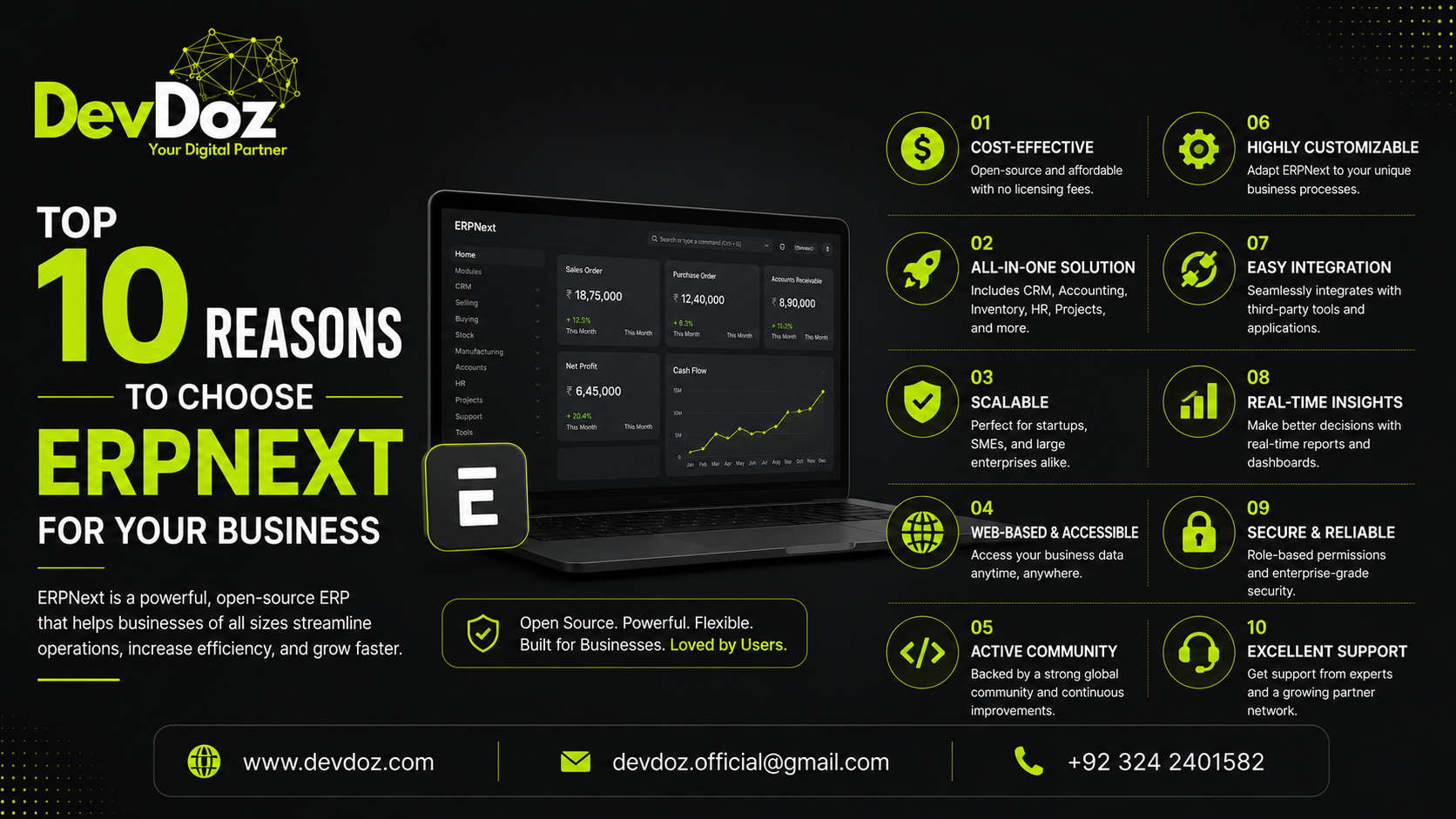
Top 10 Reasons to Choose ERPNext for Your Business in 2026
There are dozens of ERP platforms competing for your attention. This guide cuts through the marketing and explains the ten specific reasons why ERPNext stands out — from zero licensing costs and genuine scalability to its open-source flexibility and the operational advantages it delivers to businesses that implement it properly.
Choosing an ERP system is one of the more consequential decisions a growing business makes. The platform you select will sit at the centre of your operations for years — managing your inventory, your accounts, your purchasing, your sales, your HR — and switching later is expensive and disruptive. Getting it right the first time matters.
ERPNext is not the most well-known name in ERP. SAP, Oracle, and Microsoft Dynamics have larger marketing budgets and more enterprise name recognition. But for small to mid-sized businesses — and for many larger ones — ERPNext has a set of advantages that those platforms genuinely cannot match. This article makes the case honestly, with the specifics that matter, not the generic claims you will find in every ERP brochure.
At DevDoz, we implement ERPNext for businesses across multiple sectors and geographies. The reasons on this list are the ones we see making a real difference for clients — not a marketing inventory of features.
1. No Software Licensing Fees — Ever
ERPNext is released under the GNU General Public Licence v3. That means the core platform — including every module, every feature, and every update — is free to use, modify, and deploy. There is no per-user fee, no module activation charge, no annual subscription to the base software, and no fee that scales with your transaction volume or revenue.
To understand what this means in practice, consider what competing platforms charge. SAP Business One licences typically cost SAR 15,000–25,000 or more per named user annually, before implementation, training, or support. Microsoft Dynamics 365 Business Central runs from USD 70 per user per month for the essentials tier. For a business with thirty users, that is USD 25,200 per year in software costs before a single consultant is engaged.
With ERPNext, that recurring cost is zero. The investment goes into implementation, customisation, hosting, and support — work that produces value — rather than into software licensing fees that produce nothing except continued access. For small and medium businesses where capital allocation matters, this difference compounds over time into a very large number.
It is worth being clear about what "free" means here. The software is free; a good implementation is not. The investment required to configure ERPNext properly, migrate your data, train your team, and support the system post-go-live is real. But you are paying for expertise and outcomes, not for permission to use software you have already paid for.
2. One Connected System — No Integration Tax
Most businesses that have been operating for more than a few years are running on a patchwork of tools: accounting in one system, inventory in another, CRM in a third, HR in a fourth, with varying degrees of integration between them. The hidden cost of this fragmentation is substantial — in the time spent reconciling data across systems, in the errors that occur when integrations fail or lag, in the blind spots created when information exists in one system but not another, and in the sheer operational complexity of maintaining multiple vendor relationships and subscription costs.
ERPNext covers all of these functions within a single platform: accounting, inventory and warehouse management, purchasing, sales and CRM, manufacturing, HR and payroll, project management, point of sale, e-commerce, and more. When a purchase order is raised, it creates a commitment in accounts automatically. When goods are received, inventory updates in real time and the supplier invoice is pre-populated. When a sales order ships, the delivery note, the stock movement, and the revenue recognition all happen as a single connected transaction.
This integration is not a cosmetic feature — it changes the quality of information available to run the business. Financial statements that previously required a month-end reconciliation exercise are always current. Inventory decisions that previously depended on a weekly stock report can be made in real time. The management picture you have been trying to assemble from multiple data sources is simply available, automatically, because it was never fragmented in the first place.
3. Built on a Framework That Makes Customisation Clean
Every ERP vendor claims their platform is customisable. What they often mean is that you can configure settings and add custom fields within defined limits. What ERPNext means is something more substantive: it is built on the Frappe Framework, an open-source full-stack web framework that gives developers a proper, structured way to extend the platform without touching the core.
Custom applications built on Frappe sit alongside ERPNext rather than inside it. They use the same database, the same authentication system, the same UI framework — but they are maintained separately from the ERPNext codebase. This means that when ERPNext releases an update, your custom code does not break. You can upgrade the core platform with confidence, knowing that customisations are architecturally isolated from the changes being made upstream.
This matters enormously for businesses with genuinely non-standard requirements. A manufacturing business with unusual production routing logic can build that into a custom Frappe app that integrates seamlessly with ERPNext's standard manufacturing module. A retail business with a complex loyalty programme can implement it as a Frappe application that sits on top of the standard POS module. The customisation is real and sustainable — not a brittle hack that becomes a maintenance burden.
4. Genuinely Scales with Your Business
One of the most common inflection points where businesses outgrow their systems is the transition from a single location to multiple. A standalone accounting system that worked for one office does not naturally extend to three. A POS solution that managed one store cannot provide consolidated reporting across a chain of outlets without significant additional tooling.
ERPNext is designed for multi-entity operations from the ground up. Multiple companies, multiple warehouses, multiple cost centres, multiple POS profiles, multiple currencies — all are supported natively within a single installation. A business that starts with a single branch and grows to twenty can manage the entire network from one system, with each location's data visible both in isolation and as part of a consolidated view.
Beyond multi-entity support, ERPNext scales technically as well as operationally. The platform runs on standard Linux infrastructure that can be scaled horizontally as transaction volumes grow. The Frappe architecture supports load balancing and distributed deployments, and the performance improvements introduced in ERPNext v16 — the Caffeine architecture — mean that the platform handles high transaction volumes significantly better than earlier versions. You can read more about those improvements in our Frappe v15 vs v16 comparison.
5. A Modern, Usable Interface That Reduces Training Time
The reputation of ERP systems for being difficult to use is largely deserved — but it is not universal. ERPNext's interface has improved significantly over successive versions, and the v16 redesign in particular has produced a system that is noticeably more intuitive than its predecessors.
The workspace shows module-level summaries and quick-access shortcuts so users reach their most common tasks without navigating through menus. List views are fast, filterable, and configurable — users can add or remove columns, save custom views, and sort by any field. Forms are cleanly laid out with logical groupings, and the keyboard shortcuts and command palette support power users who prefer navigating by key rather than click.
For implementation purposes, this matters in a specific way: training time and post-go-live support burden are both lower on a platform that users can navigate intuitively. A warehouse operative who can find their way around the receiving workflow without constant reference to documentation is productive from day one. The interface is not the most important reason to choose ERPNext, but it is not a minor consideration either — people use what they find usable, and they work around what they find frustrating.
6. Real-Time Reporting Without a Separate Reporting Tool
One of the defining characteristics of fragmented business systems is that reporting becomes a project in itself. Data lives in different places, must be extracted in different formats, combined in spreadsheets, and validated before it can be interpreted. By the time the month-end report is ready, the information in it is already outdated.
ERPNext's reporting is integrated into the same system that processes transactions. Every sale, every purchase, every stock movement, every payment updates the underlying data immediately. Reports are run against live data, which means the numbers in a cash flow report or an inventory valuation are current at the moment you generate them, not at the close of the last period.
The platform includes hundreds of standard reports covering every module — profit and loss, balance sheet, stock ageing, purchase analytics, sales performance by customer and item, HR headcount reports, project cost summaries, and more. Custom reports can be built using the Script Report tool, which allows SQL-based or Python-based queries against the ERPNext database. For businesses with non-standard reporting requirements, the ERPNext reporting framework is one of the most capable of any platform in its class.
7. Designed for Global Operations — Multi-Currency, Multi-Language, Multi-Region
Many ERP platforms are built with a single market in mind and extended to others as an afterthought. ERPNext was built from the start for a global user base, and its multi-currency and multi-language support reflects that.
Multi-currency transactions are handled natively: purchase orders and sales invoices can be denominated in any currency, with exchange rates managed centrally and applied automatically to accounting entries. Currency revaluation for period-end reporting is supported. For businesses importing goods in USD and billing locally in SAR, PKR, or AED, this removes a significant source of manual work and reconciliation error.
Localisation is supported for a growing number of countries, including tax rule configurations for VAT in Saudi Arabia and the UAE, GST for India and Australia, and payroll compliance rules for multiple geographies. Arabic language support is included, with right-to-left layout and Arabic invoice templates available for the GCC market.
For businesses in Pakistan considering ERPNext, the platform's support for PKR multi-currency transactions, its ability to handle imports from international suppliers alongside local purchasing, and its flexible chart of accounts structure make it well-suited to the mixed domestic and international trading patterns that many Pakistani businesses operate on.
8. Continuous Development Backed by an Active Global Community
The sustainability of a software platform over time depends on whether it continues to be developed. For proprietary ERP vendors, this depends on the vendor's continued investment in the product — which can be reduced, redirected, or discontinued based on business decisions that have nothing to do with your needs as a customer. If a vendor decides to sunset a product line or shift focus to a different market segment, their customers bear the consequences.
ERPNext's development is distributed across a global community of contributors, led by Frappe Technologies in India. The ERPNext GitHub repository has over 23,000 stars and hundreds of active contributors. New features, bug fixes, and security patches are released on a regular cadence. The Frappe community forum is active with thousands of users and contributors.
This community structure means that ERPNext improves continuously because a large number of people and businesses are invested in making it better. Bugs are reported publicly and fixed transparently. Feature requests from the community can be tracked. The development roadmap is visible. For a business choosing a platform to run its operations for the next decade, this kind of transparency and community backing is a meaningful assurance of continuity.
9. Enterprise-Grade Security With Full Control Over Your Data
ERPNext's security model is built around role-based access control at a granular level. User roles can be configured to define precisely which documents each user can read, create, edit, submit, or delete. Permissions can be restricted further by document field, by company, or by custom conditions — so a regional sales manager can see their region's customer data but not another region's, without any special development work.
Every action in ERPNext is logged. Document amendment history tracks every change made to a submitted document, with timestamps and user attribution. System activity logs record login events and API calls. For businesses in regulated industries — finance, healthcare, manufacturing — this audit trail is often a compliance requirement, and ERPNext provides it natively.
Critically, self-hosted ERPNext means your data stays on your own infrastructure. Unlike cloud-only SaaS ERP platforms where your business data lives on a third-party server that you cannot directly access or control, a self-hosted ERPNext installation gives you complete ownership and control. You choose the hosting provider, the backup strategy, and the data retention policies. For businesses handling sensitive customer data or operating in industries with data sovereignty requirements, this control is a significant differentiator.
10. A Proven Platform With a Track Record Across Industries
ERPNext is not a new or experimental platform. It has been in active development for over fifteen years, with a production user base spanning manufacturing, distribution, retail, services, healthcare, education, non-profits, and more, in over 150 countries. The breadth of deployment means that the platform's core workflows have been tested against a wide range of business models and refined over many release cycles.
This matters for a specific reason: edge cases. Every industry has operational patterns that are slightly unusual — a manufacturer that does subcontracting alongside direct production, a retailer that combines wholesale and direct-to-consumer channels, a services business that bills on a milestone basis rather than a time-and-materials basis. ERPNext's deployment breadth means these patterns are well-represented in the community and, in many cases, natively supported in the platform. You are unlikely to encounter a business requirement that no ERPNext user has faced before.
The global implementation partner network is extensive. Whatever your industry or geography, there are ERPNext consultants with relevant experience. At DevDoz, our focus is on businesses across Pakistan and the GCC region, with particular depth in manufacturing, distribution, and services. For a detailed picture of what an implementation with us looks like, our 7-stage implementation guide covers the full process from discovery to post-go-live stabilisation.
Is ERPNext the Right Choice for Your Business?
ERPNext is not the right choice for every business. Very large enterprises with highly specialised requirements, deeply regulated industries with complex compliance stacks, or businesses that need a vendor with global enterprise support contracts may find that one of the larger proprietary platforms is a better fit, despite the higher cost. Honesty about this matters more than selling the platform.
But for the majority of small and medium businesses — and for many larger ones — ERPNext offers a combination of capability, flexibility, cost-effectiveness, and scalability that the major proprietary platforms simply cannot match at the same price point. The ten reasons above reflect the specific advantages that we see making a genuine difference for businesses that implement it properly.
"Properly" is the important word. The platform's potential is real, but realising it requires a disciplined implementation process — proper discovery, careful data preparation, thorough testing, role-specific training, and ongoing support. Our article on five mistakes that sink ERP projects covers what goes wrong and how to avoid it. And our guide on switching to ERPNext is a good starting point for businesses evaluating the platform for the first time.
If you want to talk through whether ERPNext is the right fit for your specific situation — what it would cover, what it would not, and what a realistic implementation would involve — get in touch with the DevDoz team. We will give you a straight answer.
Frequently Asked Questions
Related Resources
Tags
Share this article
Related Articles
Explore our latest insights, tutorials, and updates from the DevDoz team.
Is Your Business Ready for the Future? A Practical Guide to Switching to ERPNext
Discover why hundreds of growing businesses are leaving fragmented tools behind and moving to ERPNext — and how DevDoz makes that transition smooth, fast, and cost-effective.
Why Most ERP Implementations Fail — And It Has Nothing to Do with the Software
Businesses spend months evaluating ERP software, then blame the software when the project struggles. The real causes of ERP failure are almost always people, process, and planning — and they are completely preventable if you know what to look for.
ERP Implementation Failure: 5 Common Mistakes That Sink Projects — and How to Avoid Them
Most ERP projects that fail do not fail because the software was wrong. They fail because of five predictable, avoidable mistakes made in planning, execution, and people management. This is a clear-eyed breakdown of each one — and exactly what to do differently.