Don’t Let Your ERP Project Stall: The Ultimate Guide to ERP Staff Augmentation
ERP implementations don't fail because of software limitations; they fail due to sudden resource bottlenecks. Discover how strategic ERP staff augmentation injects precise engineering talent to eliminate technical gaps, accelerate delivery timelines, and maintain project momentum.
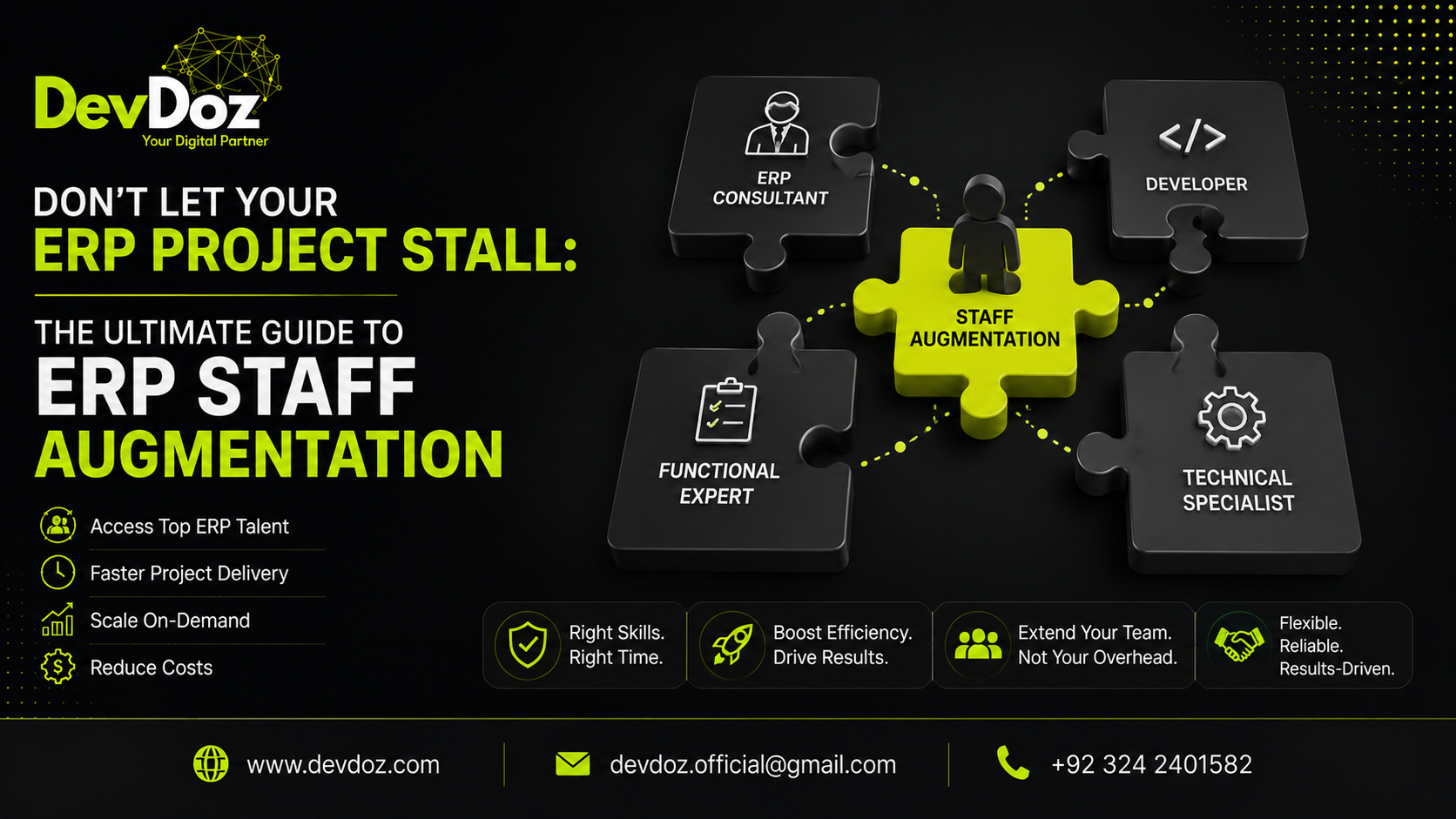
ERP implementations don't fail because of software limitations; they fail due to sudden resource bottlenecks. Discover how strategic ERP staff augmentation injects precise engineering talent to eliminate technical gaps, accelerate delivery timelines, and maintain project momentum.
There is a predictable point in mid-to-large-scale enterprise software deployments where momentum begins to decelerate. It typically occurs around month three or four of an implementation. The initial discovery sessions are long finished, the architecture is mapped, and the blueprint is approved. But as the physical build phase hits its peak, the internal engineering team encounters a hard wall of operational constraints. They are suddenly forced to balance legacy data extraction, complex API script integrations, and custom database restructuring while simultaneously handling the company's daily operational technical debt.
When this bottleneck occurs, project timelines slip. This stalling pattern rarely signals a failure of the ERP platform itself—whether you are deploying an open-source system like ERPNext or a legacy ecosystem. Instead, it is a resource optimization problem. Trying to out-hire an active project delay through traditional full-time corporate recruitment cycles is fundamentally flawed; by the time an HR team writes a job description, vets candidates, and manages a notice period, the project timeline has already shifted by quarters.
The strategic remedy to this operational challenge is ERP staff augmentation. At DevDoz, we work directly alongside engineering leads and project managers to prevent these specific delivery failures. This guide provides a direct analysis of how to leverage augmented technical talent to protect your system deployment timelines, bridge specialized knowledge gaps, and maintain deep internal ownership over your enterprise software architecture.
Understanding True Staff Augmentation vs. Traditional Software Outsourcing
To use staff augmentation effectively, operations leaders must distinguish it clearly from standard project outsourcing. Traditional outsourcing relies on an external software agency to deliver an isolated, turn-key product based on rigid requirements. The agency operates inside its own external management structure, writes code within its own closed repository, and delivers a completed application at the conclusion of a contractual period. While useful for isolated standalone apps, this model poses major structural risks for central enterprise cores, which require deep integration with daily business operations.
Staff augmentation completely reverses this dynamic. Instead of handing over control of the project to an external vendor, you inject highly targeted, vetted software engineers directly into your existing internal team structure. These augmented engineers adapt immediately to your company’s internal project management workflows—whether you use Agile sprints, Jira tracking, or automated GitHub pipelines. They write code directly into your repository, participate in daily standups, and report straight to your internal engineering leads.
This approach keeps complete architectural control and intellectual property securely within your building. Your internal team retains long-term ownership of the system's evolution, while augmented developers provide the raw technical muscle and specialized framework knowledge necessary to complete heavy development phases without technical debt.
Need to accelerate your development speed? DevDoz provides certified Frappe & ERPNext developers on flexible monthly agreements to support your custom applications and configurations. Explore our ERP Staff Augmentation Services or request a developer consult.
The Primary Catalysts: When Does an ERP Project Require Staff Augmentation?
Recognizing the early warning signs of an under-resourced implementation allows project managers to augment their teams proactively, rather than scrambling after a critical deadline has already been missed. Look out for these three core operational indicators:
1. Highly Specialized Framework Skill Gaps
Modern enterprise resource planning suites are built on specialized, high-performance web frameworks. For instance, configuring advanced automated workflows, server scripts, or custom DocTypes inside an open-source environment requires specific, production-proven mastery of the underlying Frappe Framework and python/JS architecture. If your internal team consists of highly capable generalist developers who lack experience in these specific platform layers, they will spend valuable project hours troubleshooting framework-specific quirks instead of shipping clean, scalable features.
2. Parallel Processing Blocks during Core Sprints
During the critical phases of a major deployment, multiple major modules must often be engineered simultaneously. Building a robust custom warehouse inventory tracking logic while simultaneously writing financial reconciliation structures and configuring automated procurement pipelines creates an immense parallel development load. If you rely solely on a fixed team size, you are forced to run these dependencies sequentially, which extends your time-to-market and delays your target go-live date.
3. Data Migration and Legacy System Extraction Inefficiencies
Extracting decades of disorganized, non-relational master data from legacy databases, transforming it into clean schemas, and migrating it safely into production-ready MySQL environments is one of the most resource-intensive phases of any enterprise project. It frequently consumes your core engineers' entire bandwidth, completely halting development on the actual business workflows and integrations required for deployment success.
5 Core Strategic Advantages of the Augmentation Model
Deploying a hybrid team model—where an augmented engineering layer supports your internal core team—delivers distinct advantages to an enterprise software project:
- Rapid Deployment Timeframes: Staff augmentation platforms bypass the standard 60-to-90-day corporate technical recruitment pipeline. Vetted developers with precise framework experience can onboard and begin committing clean code to your repository within days.
- High Cost Flexibility: Development demands scale non-linearly. The resource bandwidth required during intense build, integration, and data migration phases is significantly higher than headcount needed for steady-state post-go-live maintenance. Augmentation allows you to scale up engineering muscle during high-intensity sprints and scale back down gracefully once the system stabilizes.
- Elimination of Local Talent Restrictions: Finding niche engineering talent—such as developers specialized in complex relational database design, n8n workflow choreography, or enterprise business logic optimization—can be exceptionally difficult within your local geographic market. Augmentation bridges this gap by granting immediate access to a global pool of remote technical specialists.
- Seamless Knowledge Transfer: Working shoulder-to-shoulder with senior augmented engineers naturally upskills your permanent staff. Your internal generalist developers learn framework-specific design patterns, optimized scripting methods, and deployment best practices in real time as they review incoming pull requests.
- Reduced Technical Debt: Generalist teams under immense deadline pressure often write fragile code to meet timelines. Specialized augmented developers apply proven architectural patterns from day one, ensuring your configurations remain performant, safe, and easily upgradable through future software releases.
Best Practices for Onboarding and Managing Augmented Engineering Teams
To maximize the return on your technical staffing investment, your internal leadership team must establish clean operational boundaries and clear communication frameworks from day one. Treat your augmented developers as integral members of your engineering department, not as isolated third-party workers.
First, streamline your environment onboarding. Before the augmented engineers begin their first sprint, ensure your repository access, staging environments, Docker configurations, and communication channels (such as Slack, Teams, or Discord) are fully provisioned. A developer who spends their entire first week waiting on database authorization passwords represents wasted momentum and lost velocity.
Second, establish explicit, modular delivery goals. Break complex, long-term deployment goals down into concise user stories and highly detailed sprint issues. Clearly define technical criteria and code validation rules for each task—whether they are building an automated multi-level financial approval matrix or engineering a complex external point-of-sale API sync. When developers are given precise requirements and highly transparent code review expectations, they can work independently and deliver high-velocity output that seamlessly aligns with your internal development workflow.
Protecting Your Deployment Velocity with DevDoz
At DevDoz, we specialize in eliminating the engineering constraints that cause enterprise software projects to stall. We don't just supply raw development headcount; we provide deeply experienced, production-ready technical professionals who understand enterprise architecture, complex database performance tuning, and cross-system automation workflows from day one.
Whether you need to quickly resolve a complex data migration blocker, engineer custom modules on top of the Frappe Framework, or build reliable automation workflows with tools like n8n, our engineers align with your team's goals to deliver clean, maintainable software architecture. We maintain strict development standards, ensure thorough documentation, and focus on clean integrations to keep your project fully on track for a successful go-live date.
To learn more about optimizing your system deployment strategies, explore our comprehensive guide on automating your business workflows with ERPNext in 5 steps, study our strategic analysis of how ERPNext helps your business grow and scale cleanly, or review our blueprint detailing the 7 distinct stages of a successful ERP implementation.
Don't let talent shortages or sudden technical bottlenecks compromise your implementation schedule. Explore the DevDoz ERP Staff Augmentation models to secure the exact engineering talent required to execute your deployment with absolute confidence. If you are ready to start, connect with our technical consulting team today to schedule a detailed operational review of your active project.
Frequently Asked Questions
Related Resources

Ali Husnain
Frappe ERPNext Specialist & Tech Lead @ DevDoz
Muhammad Ali Husnain specializes in Frappe ERPNext architecture, custom doctype development, and AI process automations for enterprise clients across Pakistan, Saudi Arabia, and the UAE.
Tags
Share this article
Related Articles
Explore our latest insights, tutorials, and updates from the DevDoz team.
The 7 Stages of ERPNext Implementation: A Step-by-Step Guide for Businesses
Most ERPNext projects that struggle do so because they skip stages, rush through them, or treat them as formalities. This is a clear, honest walkthrough of every phase — what happens, why it matters, and what goes wrong when it is done poorly.
How ERPNext Helps Your Business Grow and Scale — Without Changing Systems Again
Most businesses hit a growth ceiling not because they run out of customers or ideas, but because their systems cannot keep up. ERPNext is built specifically to remove that ceiling — here is exactly how it does it, across every part of your operation.
Automate Your Business with ERPNext in 5 Steps: The Definitive Operational Playbook
Automating fragmented business processes doesn't require multi-million dollar corporate systems. Discover our proven, 5-step operational framework to successfully implement ERPNext automation, remove manual data entry, and scale clean workflows across your entire enterprise architecture.