What Is ERPNext and Why Do Businesses Choose It?
ERPNext is the world's most widely deployed open-source ERP system — used by businesses in over 150 countries to run accounting, inventory, sales, manufacturing, and HR from a single platform. Here is exactly what it is, how it works, and the specific reasons businesses choose it over proprietary alternatives.
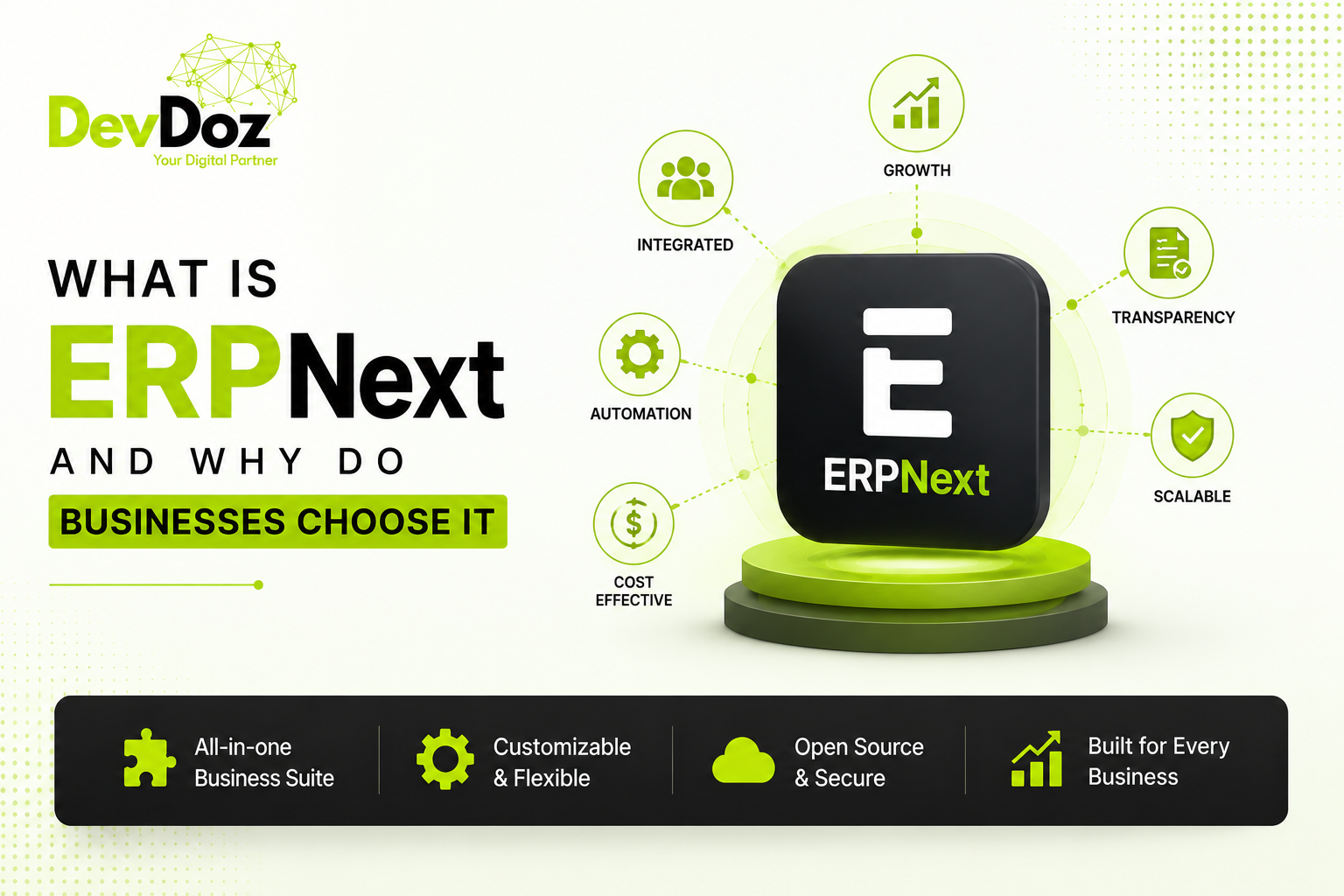
ERPNext is the world's most widely deployed open-source ERP system — used by businesses in over 150 countries to run accounting, inventory, sales, manufacturing, and HR from a single platform. Here is exactly what it is, how it works, and the specific reasons businesses choose it over proprietary alternatives.
ERPNext is an open-source Enterprise Resource Planning (ERP) system that unifies accounting, inventory, manufacturing, sales, purchasing, HR, and project management into a single connected platform. Built on the Frappe Framework and released under the GNU GPL v3 licence, it is free to use with no per-user licensing fee, and is currently deployed by businesses in over 150 countries. Businesses choose ERPNext primarily because it eliminates the cost and complexity of running separate, disconnected business tools, while remaining significantly more affordable than proprietary platforms like SAP, Oracle NetSuite, or Microsoft Dynamics 365.
That is the short answer. The rest of this guide explains exactly how ERPNext works, what makes it different from other ERP systems, and the specific, evidence-based reasons that businesses across industries and geographies are choosing it in 2026.
At DevDoz, we implement ERPNext for businesses across Pakistan and the GCC region. Everything in this article reflects what we see directly in client implementations — not marketing claims.
What Is ERPNext?
ERPNext is enterprise resource planning software that brings every core business function into one system, so that data flows automatically between departments instead of being manually re-entered into separate tools. It was first released in 2008 and is developed by Frappe Technologies, with an active global open-source community contributing to its ongoing development.
The defining characteristic of ERPNext, compared to most ERP platforms on the market, is that it is open-source. The complete source code is publicly available, can be inspected, modified, and self-hosted by anyone, and the core software carries no licensing fee. This is fundamentally different from proprietary ERP systems, where the software itself is the product being sold and licensing revenue is the vendor's primary business model.
What does ERPNext actually run on?
ERPNext is built on the Frappe Framework, a full-stack web application framework also developed by Frappe Technologies. Frappe provides the underlying architecture — database management, user permissions, the web interface, the REST API, and the workflow engine — that ERPNext is built on top of. This relationship matters because it means ERPNext is not a closed, monolithic application. Custom applications can be developed on the same framework and run alongside ERPNext, extending its functionality without modifying its core code.
What Does ERPNext Do? A Breakdown by Function
ERPNext covers the operational functions that most growing businesses need, organised into connected modules.
Accounting and finance
ERPNext provides a full double-entry accounting system. Every transaction in any other module — a sale, a purchase, a payroll run — automatically generates the correct accounting entries. This produces real-time financial statements: profit and loss, balance sheet, and cash flow reports that reflect the current state of the business, not a snapshot from the last reconciliation cycle.
Inventory and warehouse management
Stock levels update automatically with every transaction. ERPNext supports multiple warehouses, batch and serial number tracking, automatic reorder point alerts, and stock valuation using FIFO or moving average methods. Businesses can track inventory across unlimited locations from a single system.
Sales and CRM
The sales module manages the full customer lifecycle — from lead capture through quotation, sales order, delivery, and invoicing — with every interaction logged against the customer record. Sales teams have a complete history of every account without needing to consult separate systems.
Purchasing
Purchase requisitions, requests for quotation, purchase orders, and supplier invoices are managed with configurable approval workflows. The system matches purchase orders against goods received and supplier invoices automatically, flagging discrepancies before payment.
Manufacturing
For businesses that produce goods, ERPNext handles bills of materials, work orders, production planning, and subcontracting. Material consumption and production costs are calculated automatically as production orders are completed.
HR and payroll
Employee records, attendance, leave management, and payroll processing — including statutory deductions relevant to the business's jurisdiction — are handled within the platform, with payroll costs posting to accounts automatically.
Point of sale
Retail businesses can run POS billing directly connected to inventory and accounting, so every in-store transaction updates stock and financial records simultaneously, with offline support for environments with unreliable connectivity.
Why Do Businesses Choose ERPNext? The 7 Most Common Reasons
The reasons businesses choose ERPNext over the alternatives fall into seven consistent categories, based on what we see driving the decision in real implementations.
1. No licensing fees
ERPNext's GNU GPL v3 licence means there is no cost to use the core software, regardless of how many users or how much transaction volume your business has. Proprietary alternatives like SAP Business One or Microsoft Dynamics 365 charge per-user fees that scale directly with company size — often USD 70 to over USD 150 per user per month. For a 30-person team, that difference can represent tens of thousands of dollars annually.
2. A single connected system instead of multiple disconnected tools
Most businesses considering ERPNext are currently running accounting, inventory, and CRM as separate, unconnected tools. Every transaction that touches more than one of those tools requires manual reconciliation — a recurring source of errors and wasted time. ERPNext eliminates that fragmentation by design.
3. Genuine scalability without switching platforms
ERPNext supports multiple companies, multiple currencies, multiple warehouses, and hundreds of concurrent users within a single installation. A business can grow from one location to twenty, or from ten employees to several hundred, without migrating to a different system.
4. Clean, sustainable customisation
Because ERPNext is built on the Frappe Framework, custom development can be built as separate applications that integrate with ERPNext without modifying its core code. This means custom features survive platform updates — a common failure point with poorly architected customisations on other systems.
5. Full data ownership and control
ERPNext can be self-hosted on infrastructure the business controls, rather than locked into a vendor's cloud environment. For businesses with data sovereignty requirements or industries with strict compliance obligations, this control is significant.
6. An active, transparent development community
ERPNext's continued development does not depend on a single vendor's business decisions. The ERPNext GitHub repository has tens of thousands of stars and hundreds of contributors, with regular releases, public bug tracking, and a transparent roadmap.
7. A proven track record across industries and geographies
ERPNext has been in active production use since 2008 and is deployed across manufacturing, distribution, retail, healthcare, education, and services in over 150 countries. This breadth means most industry-specific operational patterns are already well-supported in the platform.
For a deeper breakdown of each of these advantages, our article on the top 10 reasons to choose ERPNext covers them in full detail, including direct cost comparisons against proprietary alternatives.
ERPNext vs Proprietary ERP: What's the Real Difference?
The most practical way to understand ERPNext is to compare it against the proprietary alternatives businesses typically evaluate alongside it.
| Factor | ERPNext | Typical Proprietary ERP (SAP, Dynamics, NetSuite) |
|---|---|---|
| Licensing cost | Free, open-source (GPL v3) | Per-user fees, often USD 70–150+/user/month |
| Source code access | Fully open and inspectable | Closed, proprietary |
| Hosting options | Self-hosted or managed cloud | Usually vendor-controlled cloud only |
| Customisation | Custom apps on Frappe, update-safe | Often requires vendor-certified consultants |
| Vendor dependency | Community-driven, no single vendor lock-in | High dependency on vendor roadmap and pricing |
| Implementation cost | Lower — no licence cost in the budget | Higher — licensing plus implementation |
| Best suited for | Small to large businesses seeking cost-effective scalability | Very large enterprises with complex global compliance needs |
Is ERPNext Right for Every Business?
No single ERP platform is right for every business, and ERPNext is no exception. It is the strongest fit for small to mid-sized businesses, and many larger ones, that want full operational coverage without proportionally scaling licensing costs as they grow. Businesses with very simple operations — a handful of transactions a week, minimal inventory complexity — may not yet need a full ERP system at all. Very large multinational enterprises with deeply specialised regulatory and compliance stacks across many jurisdictions sometimes find that an established enterprise vendor's global support contracts justify the higher cost, despite ERPNext's capability.
For the large majority of growing businesses in between those two extremes, ERPNext offers a combination of capability, flexibility, and cost-effectiveness that proprietary platforms struggle to match at the same price point.
What Does Implementing ERPNext Actually Involve?
ERPNext is free to use, but implementing it properly is a structured project, not a download-and-go process. A well-run implementation typically moves through seven stages: discovery and requirements gathering, system design, data migration planning, configuration and development, data migration and testing, training, and go-live with post-launch stabilisation. For a focused implementation covering core modules, this process typically takes ten to fourteen weeks.
Our detailed guide on the 7 stages of ERPNext implementation walks through each stage in depth, and our article on why most ERP implementations fail covers the specific mistakes that derail projects — almost always related to planning and people, not the software itself.
Frequently Asked Questions
Is ERPNext really free?
Yes, the ERPNext software is free and open-source under the GNU GPL v3 licence, with no per-user fee or subscription cost for the core platform. The investment required is in implementation services — configuration, data migration, training, and support — not in software licensing.
How is ERPNext different from SAP or Oracle?
The core difference is the business model. SAP and Oracle are proprietary, closed-source platforms with licensing fees that scale with company size. ERPNext is open-source with no licensing cost, can be self-hosted for full data control, and is extended through update-safe custom applications rather than vendor-managed customisation.
Can a small business use ERPNext?
Yes. ERPNext is used by businesses ranging from a handful of employees to several thousand. Because there is no per-user licensing fee, it is particularly accessible to small and medium businesses that would find proprietary ERP platforms cost-prohibitive at their scale.
What industries use ERPNext?
ERPNext has production deployments across manufacturing, distribution, retail, healthcare, education, agriculture, and services in over 150 countries, making it one of the most widely deployed open-source ERP systems globally.
How long does it take to implement ERPNext?
For a focused implementation covering core accounting, inventory, and purchasing modules, a properly structured project typically takes ten to fourteen weeks from initial discovery to go-live.
Next Steps
If you are evaluating ERP options and want to understand whether ERPNext specifically fits your business, the most useful next step is a direct conversation rather than further research. Get in touch with the DevDoz team for a free initial consultation — we will review your current operations and give you a straightforward, honest assessment of fit, scope, and realistic cost, with no pressure either way.
For further reading, our ERPNext 101 beginner's guide covers the platform in more depth for first-time evaluators, our guide to switching to ERPNext walks through the decision-making process, and our article on how ERPNext supports business growth explains what changes operationally once the system is in place.
Frequently Asked Questions
Related Resources

Muhammad Ali Husnain
Frappe ERPNext Specialist & Tech Lead @ DevDoz
Muhammad Ali Husnain specializes in Frappe ERPNext architecture, custom doctype development, and AI process automations for enterprise clients across Pakistan, Saudi Arabia, and the UAE.
Tags
Share this article
Related Articles
Explore our latest insights, tutorials, and updates from the DevDoz team.
Is Your Business Ready for the Future? A Practical Guide to Switching to ERPNext
Discover why hundreds of growing businesses are leaving fragmented tools behind and moving to ERPNext — and how DevDoz makes that transition smooth, fast, and cost-effective.
Top 10 Reasons to Choose ERPNext for Your Business in 2026
There are dozens of ERP platforms competing for your attention. This guide cuts through the marketing and explains the ten specific reasons why ERPNext stands out — from zero licensing costs and genuine scalability to its open-source flexibility and the operational advantages it delivers to businesses that implement it properly.
ERPNext 101: A Beginner's Guide to Understanding and Implementing ERPNext
If you have never used an ERP system before and are trying to understand what ERPNext actually is, what it does, and whether your business needs one, this guide is written specifically for you — in plain language, with no assumed knowledge.